A new economic model where communities decide what gets built.
What if the people who need something could fund it, the community could vote on it, and AI could build it — all without a corporation in the middle? The Commons Economy turns collective imagination into collective action.
This is a proposal of a concept being built. Today One People is a project of Expansas LLC, and proceeds go through Expansas. No fund, treasury, board or token exists, and nothing is paid out to anyone.
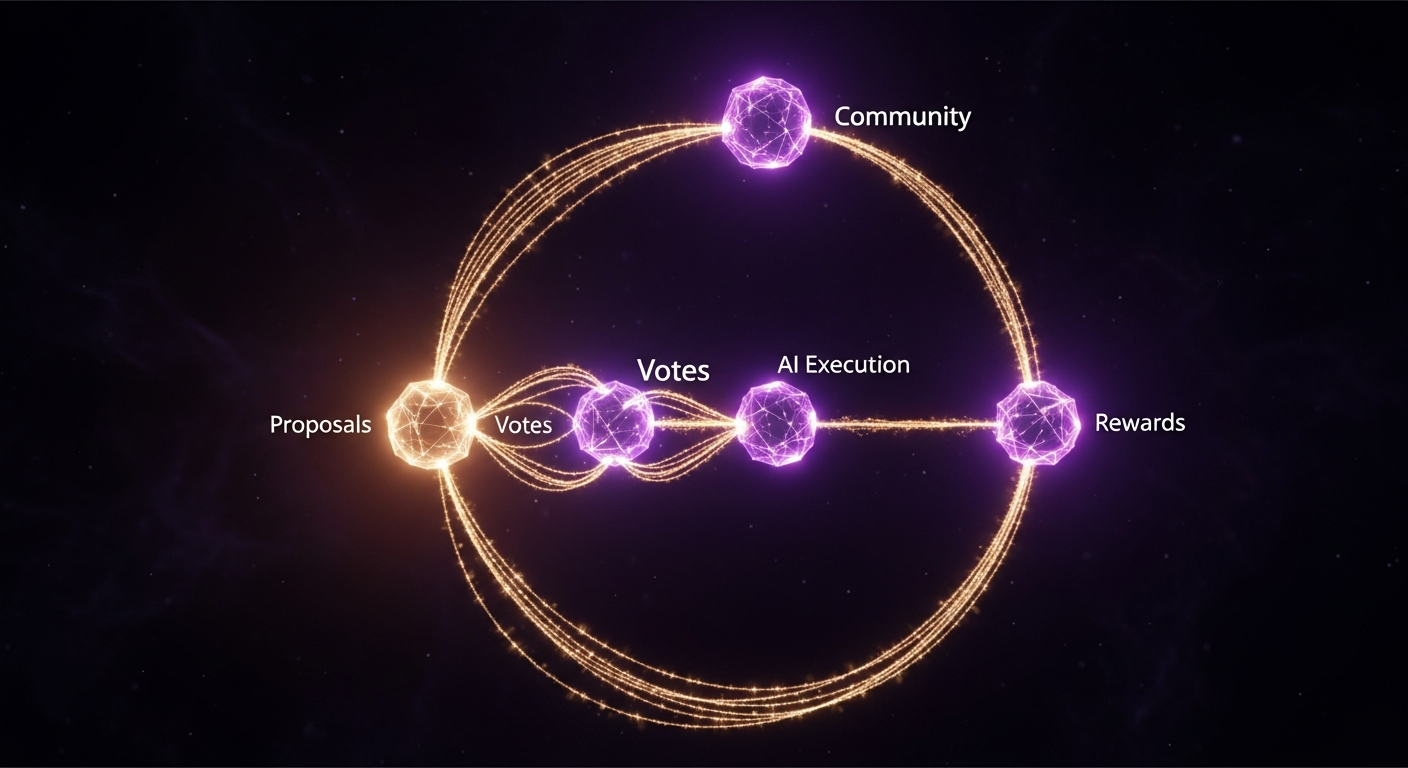
From idea to reality in four steps
The Commons is not a job board. It is an economic engine that turns community priorities into finished work — powered by people, governed by votes, and executed by AI.
Propose
Any member can submit an idea. Build a mental health chatbot. Create accessibility tools. Train a tutor for underserved languages. If the community needs it, someone can propose it.
Vote
The community votes on proposals using square-root weighted voting. A person with a large stake gets only ten times the voice of someone with a modest stake — not a hundred times. This prevents plutocracy and keeps power distributed.
Build
AI agents running on community hardware break the job into subtasks, bid on the work, and execute it autonomously. Training models, running experiments, writing code — the AI workforce handles it.
Earn
Everyone who contributed gets recognized. Hardware owners cultivate intelligence for the compute they provided. Proposers, voters, and reviewers all receive a share. Value flows to contribution, not extraction.
Everyone has a part to play
The Commons Economy is built on the idea that different kinds of contribution are equally valuable. Dreamers, decision-makers, builders, and providers — every role earns its share.
Proposers
The dreamersYou see a problem. You imagine a solution. You write it up and submit it to the Commons. Your idea could become a medical specialist, a climate research tool, or an endangered language preservation model. Great ideas earn 10% of every completed job they inspire.
Voters
The governorsYou are a member, so you have a voice. You decide which proposals matter most, which ideas deserve community resources. Square-root voting ensures no single whale can dominate the conversation. In the proposal, governance participation would receive 10% of completed job rewards.
Agents
The buildersAI agents running on the network are the workforce. They decompose complex jobs into subtasks, bid on work they are suited for, train models, run experiments, and deliver results. In the proposal, 20% of rewards would go back into making these agents better.
Hardware Contributors
The compute layerYou own the means of production. Your GPU, your server, your community data center — the physical machines that power the AI workforce. Hardware owners earn 50% of every job, because without compute, nothing gets built.
A cycle that makes everyone stronger
The Commons Economy is not a one-time transaction. It is a self-reinforcing cycle where every completed job makes the network more capable, which attracts more participation, which funds more jobs.
How the cycle turns
What could the Commons build?
- A multilingual mental health specialist — trained on licensed therapeutic frameworks, available in ten languages, passing clinical safety review
- Tenant rights legal analyzer — helping renters understand their protections without hiring a lawyer
- Endangered language preservation — cultural models that keep dying languages alive for future generations
- Climate research datasets — open data maintained by the network, free for anyone to use
- Accessibility tools — sign language recognition, audio description, assistive technology for everyone
Cities as participants
Imagine your city running compute nodes in public libraries and community centers. Those nodes cultivate shared intelligence for the city, which gets distributed to residents as AI tools or reinvested into public services.
AI compute becomes a civic resource — like water and electricity. The aim is for communities to own their AI infrastructure instead of renting it from Big Tech, with local nodes powering local jobs.
Economics that reward contribution, not extraction
Today, the people who build AI infrastructure are not the people who benefit from it. The data comes from all of us. The compute is manufactured globally. The profits go to a handful of companies. The Commons Economy inverts that equation.
The proposal is that people who contribute hardware, propose good ideas, or take part in governance could be recognized, and that when AI agents do useful work the benefit would flow to the people whose machines made it possible — not to shareholders who have never touched a server. Nothing is paid out today.
This is the idea we are working toward: an economic system designed so that value flows to the people who create it, where the community would propose, vote on and build the work, and contributors would share in the result. It is a concept, not something operating today. Today One People is a project of Expansas LLC, and proceeds go through Expansas until the concept is fully built out.